Fashion in the 1500s-1600s Fashion in the 1500s-1600s in England
Wearing apparel in the Elizabethan era (1558-1603 CE) became much more colourful, elaborate, and flamboyant than in previous periods. With Elizabeth I of England (r. 1558-1603 CE) herself being a dedicated follower of style, so, too, her court and nobles followed suit. Clothing was an of import indicator of status so that those who could afford it were careful to clothing the right colours, materials, and latest fashions from Continental Europe. Heavy brocade, stockings, tight-plumbing fixtures doublets, long billowing dresses embellished with pearls and jewels, knee-length trousers, strong linen collars or ruffs, and feathered hats were all staple elements of the wardrobes of the well off. The commoners, meanwhile, attempted to follow the new designs every bit best they could using cheaper materials, simply those who tried to dress beyond their station had to beware the government did not fine them and confiscate the offending item.
The Historical Record
Reconstructing what exactly people wore and when has its problems. Material, of grade, is not a very good survivor at the all-time of times. There are a few rare surviving examples such as a woollen shirt and breeches set belonging to a man who died after falling into a peat bog on the Isle of Shetland. However, these are few and far betwixt. In addition to the ravages of fourth dimension, the Elizabethans typically repaired and then cut and reused their dress to get the longest life from them. The shabbiest clothes would and so accept been used as rags. Consequently, our cognition of Elizabethan style often comes from secondhand sources such equally written descriptions, sumptuary laws, and representations in art.
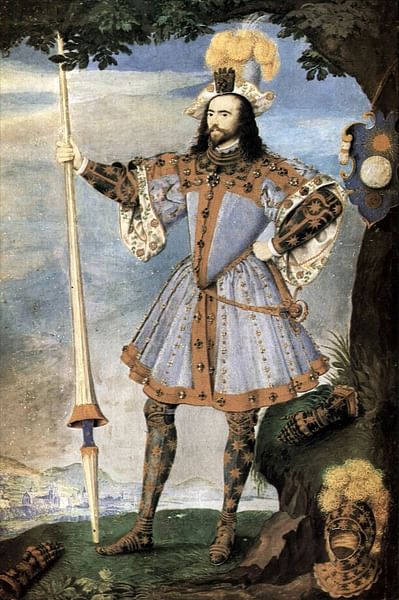
George Clifford, Earl of Cumberland
Every bit the Elizabethan period wore on, regions like East Anglia & Kent saw the arrival of immigrants (specially Dutch & Italians) with fabric-manufacturing skills.
The Material Trade
The increasing population of England in the 16th century CE stimulated a respective growth in the fabric and wear industries. Wool was the primary material and at that place were four sheep for every person in England in the 1550s CE. At the same time, an increased contact with northern Europe saw new ideas and fashions spread, creating a demand for brighter colours and lighter materials. Unworked and undyed cloth was England's almost important export, specially to Antwerp. However, inflation and disruptions to international trade acquired past the Anglo-Castilian war led to a refuse in the 2d one-half of the 16th century CE.
The manufacture of clothing for the domestic market became more sophisticated with a greater use of small machines to help in some stages of the process. These included the Dutch loom and stocking-frame knitting machine. The in one case staple wool, felt, and worsted clothing was now supplemented with lighter fabrics - specially cotton fiber, linen, fustian (cotton fiber and linen), and sometimes silk - while even the traditional materials became finer in quality and texture. Yarnspinners, weavers and dyers all worked independently and usually in their own homes. There were, as nonetheless, no factories, fifty-fifty if workers were semi-professionals and many various households might produce for a single large-calibration dealer, known as a clothier.
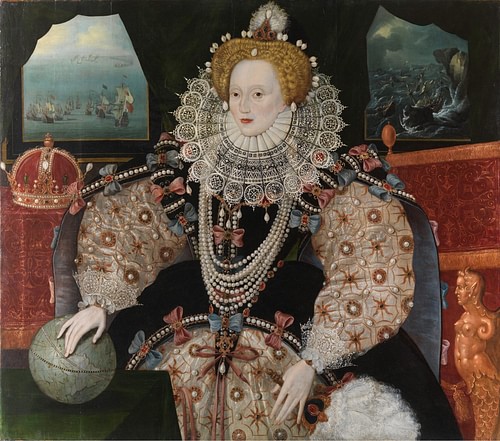
Elizabeth I Armada Portrait
The Welsh borders, Gloucestershire, Wiltshire and Hampshire had long-enjoyed a reputation as the best places for English language cloth industry. As the Elizabethan period wore on, regions like East Anglia and Kent saw the arrival of immigrants (specially Dutch and Italians) with cloth-manufacturing skills, which greatly increased the quality of local production. Hybrid fabrics lighter than the traditional English language ones were produced which created new need and, considering they wore out quicker, increased sales in the longterm. The new varieties of cloth or 'new draperies' went under many names such as bays, says, serges, perpetuanas, shaloons, and grosgraines.
The Elite
Men's Clothes
For men, linen underclothes (shirt and long shorts) were oftentimes embroidered and given lace decoration. Outer clothing was fabricated of all the materials mentioned above. Additional options worn merely by the aristocracy considering of their expense included velvet, damask (an elaborately woven fabric of various material), and silk. Trousers were knee joint-length ('Venetian breeches') or thigh-length (trunkhose), and were frequently billowed out over the upper thighs and hips; later versions had pockets. Trousers ofttimes featured a codpiece which was a padded roofing of the crotch. Sometimes of impressive proportions (but less so than during Henry VIII of England's reign, 1509-1547 CE), the codpiece could be unbuttoned or untied separately from the trousers when required. By the end of the century, they were replaced by the push or tied fly.
The most common upper garment for men was the doublet, a short, stiff, tight-fitting jacket which was made of wool, leather, or thick fabric. Only as today, small-scale changes became a sign of fashion such as the lower hem of the doublet, which started off straight simply and then adult into a deep V-grade pointing downwards at the front. A curiosity of some doublets was the peascod - actress padding over the abdomen to imitate armour simply which ended up making the wearer look as if he was strutting like a peacock. Such padding, known as 'bombast', consisted of wool, cotton fiber or horsehair and was used in other areas to create fashionable shapes to outer clothing. Detachable collars and cuffs were highly fashionable likewise and were made from stiffened linen or lace. Every bit the century wore on the ruffs became ever-more outlandish and required wire supports.
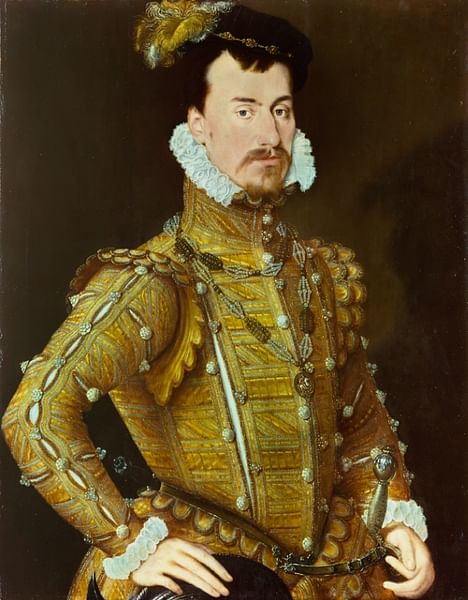
Robert Dudley, Earl of Leicester
The doublet might have sleeves which could be detachable and it was closed using hooks, laces, or buttons. The shoulders could have wings and decorative tabs hanging at the waist known equally 'pickadills'. On top of a doublet in colder weather, a man might wear a jerkin waistcoat and on pinnacle of that a coat which could be of whatever length, cutting, and material. Cloaks and semi-circular capes were also worn. Trousers and upper garments were often slashed vertically in places so that underclothing or a lighter lining material could bulge through the gaps in a decorative way.
Some dyes were expensive to produce such equally cherry & black & so these were another indication of wealth & condition.
Leather was popular for some outer garments, belts, gloves, hats, and shoes. Leather was sometimes made more decorative by tooling information technology. Shoes for men were typically square-toed and without a noticeable heel. Earlier types of footwear were slip-on, but laces and buckles came into fashion by the finish of Elizabeth'due south reign. Courtiers often wore fancy slipper-like shoes made from silk or velvet. Leather boots were worn when riding.
Colours often assorted in the same outfit. All colours came from natural dyes and so the most common for the aristocracy were red, blue, yellowish, green, gray, and brown. As natural dyes tend to fade relatively quickly (although outer clothes were rarely washed at all but were only brushed), wearing the brightest colours clearly showed one had the newest of dress. Some dyes were expensive to produce such as ruddy and black and and so these were another indication of wealth and status. Buttons, typically pocket-sized in size simply large in number, were a similar bluecoat of wealth with the cheapest using wood, bone or horn and the more than dazzling made using gilt, argent, or pewter. Similarly, instead of buttons a garment might be closed or joined to another by tying a ribbon through matching holes. These ribbons were known equally 'points' and the ends could exist decorated with pieces of metal. In the absenteeism of pockets, both men and women wore belts or girdles from which were suspended purses, daggers, and rapiers for men, and mirrors, training kits, and fans for women.
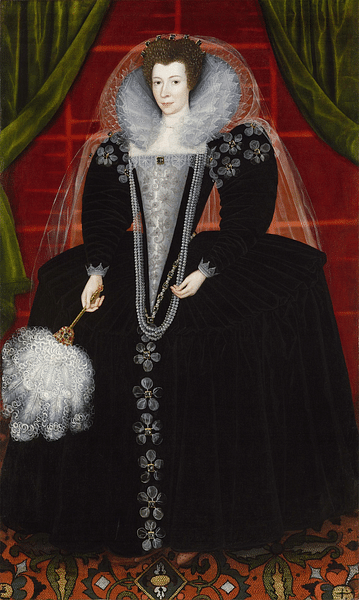
Elizabethan Lady in Farthingale Clothes.
Aristocratic women often wore long dresses which had not changed very much since the Eye Ages. The kirtle apparel was fitted and very long so that the feet of the wearer were nearly hidden. On meridian of this other garments were worn. Skirts were free-flowing early in Elizabeth's reign, but there then adult a fashion for rigid skirts in the shape of a bell or cylinder. These forms were created by a series of hoops inside the material or in an undergarment. This latter construction was known as a wheeled farthingale and it had a padded roll around the waistline to push the exterior garment outwards so that the cloth of the dress and so fell perpendicular.
An alternative to the kirtle was wearing a series of low-cal skirts (petticoats) combined with a bodice which was usually a potent garment made from wool and which emphasised a narrow waistline. Bodices gave support to or even constricted the upper body. They were given rigidity by inserting thin pieces of whalebone, wood or metal. Finer bodices were airtight using buttons or hooks. Sometimes a reinforcing slice of wood called a 'busk' was inserted at the front of the bodice and held in position using a ribbon in the heart of the breast (which survives to this day in some undergarments). The bodice could be attached at the front end, side or back. As with the hemlines of men'southward waistcoats, the neckline of women'south bodices varied in cut. In the mid-16th century CE, the cut was low, and so rose over time and finally became low-cut over again by the end of the century. Aristocratic women wore sleeves to their bodice if it were worn equally an outer garment.
A third alternative was to wearable a gown which was essentially a skirt and bodice attached together and worn over undergarments. These were the virtually improvident of the Elizabethan garments and were typically worn with false sleeves and decorated with pearls, jewels and gold brocade.
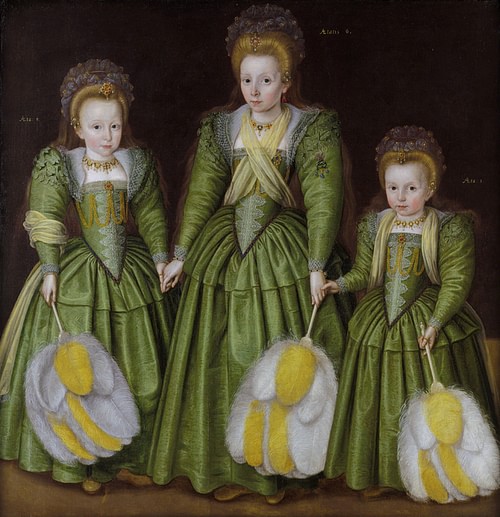
The Egerton Sisters
The Commoners
Commoners wore similar dress to the aristocracy simply made along much simpler lines and with cheaper materials. Workers obviously did not wear restrictive wear when doing their daily tasks. Materials such as cheaper linen, linen canvass, hemp canvas, and lockram (from fibroid hemp) were all used for everyday working clothes that needed to be durable to wearable and weather. For this reason, hems were sometimes fabricated of more durable material and so that they could take the extra vesture and tear and be easily replaced if necessary to give the garment a longer life. Aprons of thick cloth or leather were worn to protect wearing apparel, also. For a special outfit, an affordable luxury was satin (about 10 times cheaper than damask). As some dyes were expensive, gray and brown shades were the well-nigh common colours in the article of clothing of the poorer classes.
Travelling salesmen and local mercers would take sold uncomplicated clothes like stockings and underclothes. For more elaborate outerwear, a specialised tailor or seamstress would have made the clothes on demand. Hose or loose-fitting stockings remained popular with men, although fashionable aristocrats would have preferred trunkhose. Shorter stockings tied with a garter and ribbon at the knee were popular with all classes. Lower class women sometimes wore sleeveless bodices and fastened them using laces, something upper-form women did not exercise. A wool or linen cap or flat lid was commonly worn, fifty-fifty indoors. Hats for the rich were sometimes fabricated with fur (especially beaver) while commoners might use straw, felt, or leather. Shoes were as mentioned above but workers sometimes wore ankle-boots fabricated of leather.
Silk, ribbons, and lace were luxury items merely could exist easily added in moderation to even manifestly clothes to make them more than attractive. This was especially so as the English language followed the manner trends set by the French and Italians whose upper classes favoured more ostentatious clothing. The trend for elaborate decoration and then trickled down to all classes.
Controlling Fashion
Elizabeth was the last monarch to impose sumptuary laws (notably in 1559 and 1597 CE) to adjourn extravagant spending on clothing and ensure the elite remained the simply ones with the finest apparel. In that location was genuine business that young men, in particular, outspent their inheritances in trying to continue up with the fashions set by the richer members of club. Consequently, in that location were strict rules on who could habiliment certain types of dress, sure materials, and certain colours. There were other reasons to limit dress such equally the religious views of Protestantism that called for more than austere habiliment, and the fact that finer and more dazzling clothes typically came from away and so hurt the sales of plainer habitation production.
Examples of restrictions included merely earls or college ranks beingness able to wear gold cloth. Only royalty could article of clothing royal and merely peers and their relations could wear wool garments fabricated abroad. Servants of anyone lower than a admirer could not wear fur of any kind, and commoners were banned from wearing stockings made from cloth costing more a certain cost per thousand. Anyone caught breaking these sumptuary laws risked diverse degrees of fines and having the article of article of clothing confiscated. The fact that such fines were in place illustrates, though, that many Elizabethans of all classes were willing to pay whatsoever cost to wear the finest fashions of the twenty-four hour period.
This commodity has been reviewed for accuracy, reliability and adherence to academic standards prior to publication.
0 Response to "Fashion in the 1500s-1600s Fashion in the 1500s-1600s in England"
Post a Comment